

No Man's Sky System Requirements
No Man's Sky System Requirements - full specs, system checker and the gaming PC setup you need.
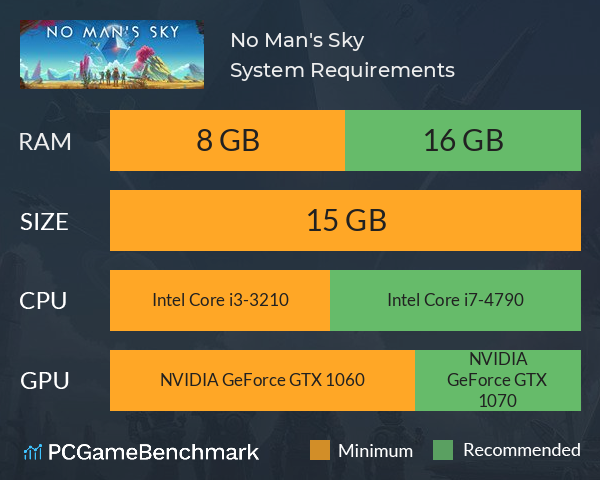
| Minimum | Recommended | |
| CPU | Intel Core i3-3210 | Intel Core i7-4790 |
| Graphics Card | NVIDIA GeForce GTX 1060 or Radeon RX 470 | NVIDIA GeForce GTX 1070 |
| RAM | 8 GB | 16 GB |
| File Size | 15 GB | 15 GB |
| OS | Windows 7/8.1/10 (64-bit versions) | Windows 10 |
Can you run it? Test your computer against No Man's Sky system requirements.
Can I Run No Man's Sky?
To run the No Man's Sky system requirements, you will need an Intel Core i3-3210 CPU, an Intel UHD graphics 630 GPU, 8GB of RAM, and 15GB of HD space.
Developer Hello Games has overhauled the No Man's Sky requirements, and now you no longer need a graphics card to run the game - in fact, it'll boot on a humble integrated GPU. Of course, using the Intel UHD graphics 630 GPU is the bare minimum, alongside 8GB of RAM and an Intel Core i3. Any old i3 should do the trick, from Intel Core i3-3210 onwards. The developer doesn't indicate what processor to aim for if you're sporting a team red CPU, but we'd say you're safe running anything from an A8-7600 APU to anything with a Ryzen sticker on the box.
While there are no recommended system requirements for No Man's Sky, you will fare better with more RAM - we always recommend 16GB of RAM for modern games - and either an Nvidia GeForce GTX 1060 or AMD Radeon RX 470 graphics card packed into your gaming PC.
You'll need 15GB of HD space at minimum to download the game, and we recommend installing No Man's Sky onto an SSD rather than a HDD to get the best performance from the game.
No Man's Sky VR
No Man's Sky works with VR headsets and the Valve Index, HTC Vive, Oculus Rift, and general Windows Mixed Relity devices are all officially supported. This came as a core feature of the Beyond update, also known as 2.0 when it released in August 2019.
No Man's Sky Performance Guide
Struggling to get a decent framerate in No Man's Sky, or having other performance issues? Here are some tips to improve performance.
- Keep shaders (and possibly other textures and details) on a lower setting - it might seem obvious to simply lower the settings, but it's important to be particularly mindful of how entering the atmosphere of a planet is more demanding than cruising around space given it has to render enormous proportions.
- Try changing your anti-aliasing settings - if it is set to the ultra setting or TAAxFXAA, then lowering your anti-aliasing by one or two steps may help your frame rate. One to look out for is SSAA, as it's resource-intensive.
- Disable HBAO - this setting is in charge of the quality of shadows, so turning it off may help your frame rate. Less shadows rendered means you should have better performance. After all, who needs shadows in space?
- Fiddle with anisotropic filtering - switching from 16x to 8x or 4x, can lessen the performance impact of details that need to be rendered.
- More RAM is better - if an upgrade is on the cards, then you might want to focus on RAM given memory is key to a buttery smooth performance. You shouldn't need any more than 16GB for No Man's Sky, though, unless you're streaming it.
- Download the latest graphics
card driver - check in with Nvidia GeForce Experience or AMD Adrenalin
(the Radeon software) to see whether or not your GPU has the latest
patch. Sometimes driver updates can fix issues you wouldn't expect.
No Man's Sky will run on PC system with Windows 7/8.1/10 (64-bit versions) and upwards. Additionally it has a Mac version.
Looking for an upgrade? See our graphics card comparison and CPU compare for benchmarks. We'll help you find the best deal for the right gear to run the game.
No Man's Sky FPS - what frame rate can you expect?
How many FPS will I get on No Man's Sky? An FPS Monitor is the first step in understanding how the parts in your gaming PC are actually performing in real-world conditions. It's the perfect way to track No Man's Sky FPS drops and stutters.
Download our free tool on Overwolf to count your frame rates as you play, and test how tweaks to your settings can boost FPS and increase No Man's Sky performance. Our app is compatible with hundreds of the best PC games and available now.
No Man's Sky Mac OS system requirements (minimum)
- Memory:8 GB
- Graphics Card:AMD Radeon R5 M230
- CPU:Intel Core i5-12400T
- File Size:15 GB
- OS:macOS Monterey 12.3
No Man's Sky Details
| Player Count | 59,245 Players (Last 24 Hours) |
| Review Score | 61 / 100 |
| Download | No Man's Sky Download |
| Categories | Action Adventure FPS |
| No Man's Sky Release Date | 12th of August 2016 |
| No Man's Sky PC price today | $59.99 |
No Man's Sky is a game about exploration and survival in an infinite procedurally generated universe.